The Hidden Tax Exposure Sitting Inside Your Assignment Letters
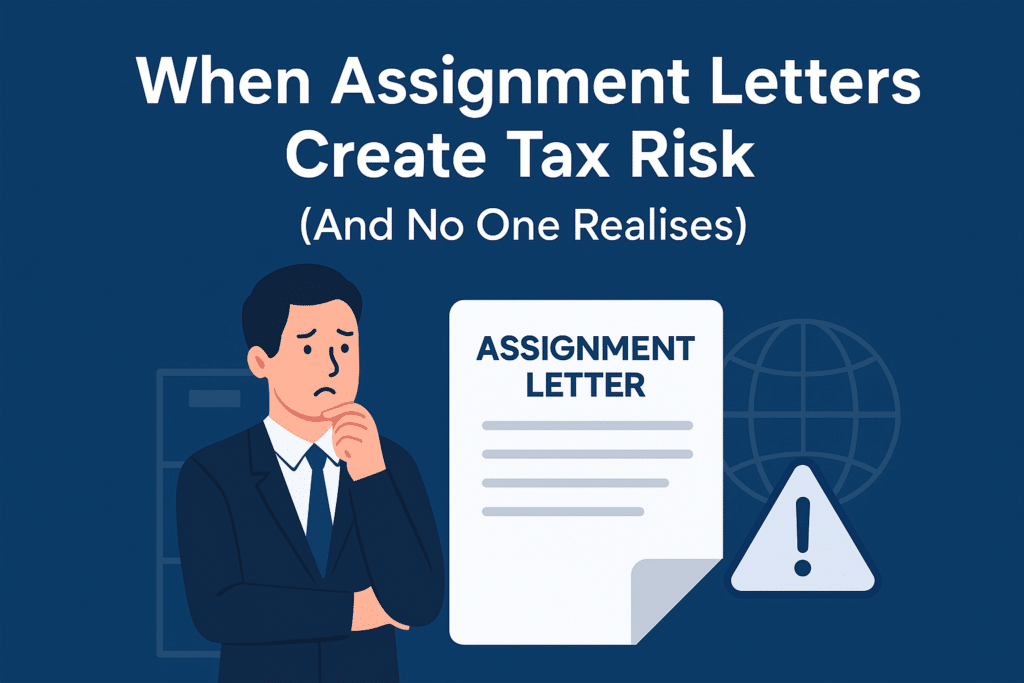
Most organisations treat assignment letters as administrative paperwork — something HR drafts, Legal reviews, and employees sign. They’re rarely reviewed by tax, and almost never by someone who understands how tax authorities interpret cross‑border employment arrangements.
That’s precisely why assignment letters tax risk is one of the most common — and most preventable — global mobility failures we see.
The issue isn’t dramatic. It’s not about aggressive planning or complex structures. It’s about ordinary assignment letters quietly creating tax exposure because of small drafting errors:
- compensation that doesn’t match payroll reporting
- assignment dates that don’t align with immigration or tax filings
- benefits described in ways that trigger unintended tax treatment
And because these issues are embedded in documentation, they often go unnoticed for years — until a tax authority reviews them retrospectively.
This article breaks down why assignment letters create tax risk, how the problem typically surfaces, and what earlier intervention looks like in practice.
The Assumption Employers Make
“It’s just an HR document” — the most common misconception
Most HR and legal teams see assignment letters as:
- a communication tool
- a record of agreement
- a way to outline compensation and benefits
- a document to support immigration applications
What they don’t see is that tax authorities treat assignment letters as evidence of the employment relationship, and therefore:
- evidence of where work is performed
- evidence of who bears employment costs
- evidence of who directs and controls the employee
- evidence of whether a Permanent Establishment (PE) may exist
This is why assignment letters are often requested during audits — especially in situations where short‑term assignments create PE exposure and when the employee works remotely from a foreign country, assignment letters can also be used to assess remote work PE risks.
The latter has become such common practice that, in the 2025 update to the OECD Model Tax Convention (the template used by countries in the OECD to negotiate, draft and update bilateral tax treaties), new commentaries have been added which provide, inter alia, additional clarity on cross-border working from home (and other places) arrangements.
The assumption that “tax will follow payroll”
Another common belief is that payroll reporting determines tax treatment.
In reality, documentation determines tax treatment, and payroll must follow.
When assignment letters contradict payroll, tax authorities assume payroll is wrong — not the document.
This is why mismatches between assignment letters and payroll often lead to assessments, especially when tax equalisation clauses are included but not implemented — a failure explored in why tax equalisation systems break.
Why It’s Risky – Compensation Descriptions That Don’t Match Reality
This is the most frequent failure point.
Examples of mismatches that trigger tax exposure
- The assignment letter states the employee will receive a “cost‑of‑living allowance”, but payroll reports it as a bonus.
- The letter describes housing as “company‑provided”, but payroll treats it as a taxable benefit (ignoring tax relief’s such as the UK Detached Duty Relief).
- The letter states the employee will remain on home payroll, but shadow payroll is not operated in the host country.
- The letter includes a tax equalisation clause, but the company never actually performs tax equalisation calculations.
- The assignment letter is silent on home and host country social security contributions resulting in the local shadow payroll being run as a standard local hire payroll for social security purposes.
These inconsistencies poorly worded assignment letters create
- under‑ or over- withholding
- potential incorrect / double social security contributions reporting
- double taxation and/or higher taxes being born by the employee than it is needed
- fringe benefits misclassification and misreporting
- employer liabilities for back taxes (plus interest and penalties)
- costly employee’s disputes and settlements once they realise, they are out of pocket compared to if they had not gone on assignment and remained in their home country
This is where understanding when a shadow payroll is required becomes essential.
The OECD Commentaries on Article 15 (para. 8.13 – 8.15) explain that determining the “economic employer” requires analysing who directs the employee’s work, who bears the associated costs, and how contractual arrangements reflect the underlying reality.
This is why assignment letters — as contractual evidence — carry so much weight.
Incorrect Assignment Dates
Assignment dates are not administrative details. They determine:
- tax residence
- social security coverage
- treaty relief eligibility
- payroll withholding obligations
- PE risk exposure
Common date‑related errors
- Assignment start date is earlier than the immigration start date.
- Assignment end date is extended informally but never updated in documentation or in terms compliance (i.e. nobody checks if a Certificate of Coverage needs to be also extended)
- The employee travels before the assignment letter is finalised (or has already been working in the host country for weeks).
- The assignment letter uses calendar dates, but payroll uses pay‑period dates.
These discrepancies create timing mismatches that tax authorities may interpret as non‑compliance.
This is particularly common in organisations with decentralised management structures — a risk explored in why decentralised management creates hidden risks.
Assignment dates also determine social security coverage, which is why understanding A1 Certificate requirements (even for short business trips) and how Certificate of Coverage insurance works is essential.
And when travel patterns shift unexpectedly, organisations often overlook how travel patterns affect tax residence.
Benefit Misclassification
Assignment letters often include benefits described in vague or inconsistent terms:
- “housing support”
- “cost‑of‑living adjustment”
- “mobility premium”
- “hardship allowance”
- “family support”
- “travel assistance”
Tax authorities don’t interpret these terms the way HR does.
This disconnect between documented intent and operational reality becomes particularly problematic when expats tax residence is reviewed retrospectively.
In practice, authorities often test what actually happened on the ground against what was documented at the outset, which can lead to unexpected reassessments long after the assignment has begun or even ended, as seen in cases where expat tax residence is assessed retrospectively.
Why this matters
Different benefits have different tax treatments depending on:
- the country
- the employee’s tax residency
- whether the benefit is cash or in‑kind
- whether the benefit is employer‑provided (paid directly by the employer to a vendor) or reimbursed
- whether the benefit is linked to business necessity
A poorly worded benefit clause can turn a non‑taxable reimbursement into a taxable allowance — or vice versa.
This is especially true in cross‑border remote working arrangements, where benefits often blur the line between business necessity and personal convenience.
And because tax treatment varies by jurisdiction, organisations must understand country‑specific expat tax regimes like the French Régime Des Impatriés for instance.
How the Issue Typically Surfaces
A realistic case study (based on common patterns)
The scenario
A UK‑based technology company sends an employee to Germany for a 12‑month project. HR drafts the assignment letter, sorts out work permit and A1 certificate. Legal reviews it for employment law compliance. No one sends it to tax.
The assignment letter states:
- the employee will remain on UK payroll
- the employee will receive a “mobility allowance”
- housing will be “company supported”
- the assignment will run from 1 January to 31 December
- the employee will be tax equalised
What actually happens
- The employee travels early in December for onboarding.
- Payroll treats the mobility allowance as a bonus.
- Housing is reimbursed, not provided directly.
- No shadow payroll is operated in Germany.
- The assignment is extended informally to 18 months.
- No tax equalisation calculation is ever performed.
How the issue surfaces
Two years later, the German tax authorities conduct, likely as a result of information exchange with HMRC (who had issued the A1 Certificate) under the Common Report Standards protocol, a routine employer audit. They request:
- assignment letters
- travel records
- payroll data
- expense reports
They immediately notice:
- the assignment letter contradicts payroll
- the employee was physically present earlier than declared
- benefits were misclassified
- no German payroll was operated and no German taxes paid via a German tax return for the employee on assignment
- the assignment exceeded 183 days
- the assignment was extended without documentation
This type of audit trigger is consistent with cross‑border secondment audit triggers.
It also mirrors the issues seen in expat assignment cost overruns, where poor documentation leads to unexpected liabilities.
The outcome
The employer is assessed for:
- back taxes
- late payment interest
- penalties
- employer social security contributions
- potential PE exposure
The employee also receives a personal tax assessment — and disputes it (via their own appointed employment lawyer), because the assignment letter promised tax equalisation.
The employer ends up settling out of court with the employee for thousands of GBPs and at the end of it all, the employee leaves the company out of frustration with how his assignment went.
The lesson learnt
The tax risk wasn’t caused by aggressive planning.
It wasn’t caused by the employee.
It wasn’t caused by payroll.
It was caused by an assignment letter drafted without tax input, which created a chain reaction of mismatches.
What Earlier Intervention Looks Like
This is the single most effective control.
1. Tax review before assignment letters are issued
A tax review ensures:
- compensation descriptions match payroll capability
- benefits are classified correctly
- assignment dates align with immigration and payroll
- tax residency implications are understood
- social security coverage is confirmed
- PE risk is assessed
2. A standardised assignment letter template — but with tax‑critical fields
Templates are useful, but only when they include:
Tax‑critical elements:
- clear assignment start and end dates
- explicit payroll location(s)
- shadow payroll requirements
- tax equalisation or protection terms
- benefit definitions aligned with tax treatment
- cost‑bearing entity
- confirmation of who directs and controls the employee
These fields prevent the most common mismatches.
3. A governance process that links HR, tax, payroll, and immigration
This is where most organisations fail.
A decentralised process means:
- HR drafts the letter
- Legal reviews it
- Payroll receives it after the fact
- Tax is never involved
A centralised governance model ensures:
- one team owns the assignment lifecycle
- documentation, payroll, and filings align
- extensions and changes are captured
- benefits are tracked consistently
- tax equalisation calculations, extension applications and so on are actually performed
4. Annual reviews of existing assignment letters
Most tax risk arises not at the start of the assignment, but during:
- extensions
- changes in role
- changes in compensation
- changes in family circumstances
- changes in travel patterns
An annual review ensures the assignment letter still reflects reality — and that payroll and tax filings still align with the document.
This is particularly important for cross‑border remote working arrangements where employees’ travel patterns shift unpredictably as well as for employees who sit in the grey area between business travellers and formal assignees, where accidental expats quietly trigger compliance risks.
Final Thoughts: Why Assignment Letters Deserve More Attention
Assignment letters are not administrative paperwork.
They are legal evidence of the employment relationship — and tax authorities rely on them heavily.
Most assignment letter tax risk is unintentional. It arises because:
- HR drafts the document
- Legal reviews it
- Payroll interprets it
- Tax never sees it
And yet, tax authorities treat assignment letters as the authoritative source of truth.
If your organisation has not reviewed its assignment letter process recently, or if you suspect mismatches between documentation and payroll, it is worth taking a closer look.
Not many companies have the experience or cross‑functional visibility needed to assess assignment letter tax risk from a 360° perspective.
Addressing these risks often requires more than correcting individual documents after the fact.
In practice, organisations need to decide whether they are seeking technical compliance support or broader advisory input when engaging external specialists.
Understanding the difference between cross border tax accountants and consultants — and when each is appropriate — can significantly influence whether assignment-related risks are identified early or only discovered once positions are challenged.